
Last Updated: November 15, 2026
Quick Summary
The best group dining menu for sharing is one that offers sharing platters as a standard option, mixes proteins such as seafood and grilled meats, and states its per-person price and what it includes. Compare venues on the all-in cost, including service charge and VAT, and on whether their maximum table size fits your group.
- Check whether sharing platters are a standard menu option or only an add-on.
- Choose a menu that mixes proteins so seafood lovers and meat eaters are both satisfied.
- Ask each venue for the all-in figure, including service charge and VAT, in writing.
- Work out how many guests one platter serves alongside sides before ordering.
- Confirm the deposit, pre-order deadline and table time limit before you commit.
Table of Contents
- What Makes a Group Dining Menu Work for Sharing
- Side-by-Side Comparison of Group Menus, Prices and Group Sizes
- Sharing Platters for Groups: Seafood, Grilled Meats and Mixed Grills
- Choosing a Seafood Restaurant for Groups of 15 to 30
- Planning Dietary Needs, Booking Rules and Total Cost
- Finding the Right Restaurant for Your Group Celebration
- Booking Your Group Table at Monika Restaurants
- Frequently Asked Questions
Choosing somewhere for a group meal in London often comes down to one question: which menu will actually work for sharing? This guide looks at what makes a group dining menu work well for sharing, and how to compare the options before you book.
A group dining menu is a set of dishes designed to be ordered and eaten together rather than individually. Where the menu leans on shared platters, the practical question is whether the portions, pacing and choice suit everyone at the table, including people who eat differently.
What Makes a Group Dining Menu Work for Sharing
The strongest group menus combine a few distinct elements. They offer enough variety that not everyone has to eat the same thing, portions that spread across a table, and a kitchen that can send dishes out in a sensible order.
Look for three things when reading a menu. First, check whether sharing platters are offered as a standard option or only as an add-on. Second, check whether the menu mixes proteins, so a seafood lover and a meat eater can both be satisfied. Third, check whether the restaurant describes its cooking method.
Side-by-Side Comparison of Group Menus, Prices and Group Sizes
Most group-dining pages list a set menu and a per-person price and stop there. The gap is a comparison you can actually act on: what each format includes, how many diners it realistically serves, and what the total comes to once service charge and drinks are added. Use the framework below to line up any two or three venues on the same terms, then ask each one to confirm the figures in writing for your date and headcount.
| Factor | What to record for each venue | Why it changes the decision |
|---|---|---|
| Menu format | Set group menu, sharing platters, or à la carte | A set menu fixes cost per head; platters need a portion calculation; à la carte is hardest to budget for a large table |
| What is included | Number of courses, sides, bread, tea or coffee | A 'three-course' menu that excludes sides can cost more once you add them |
| Price basis | Per person in GBP, or per platter | Per-person is predictable; per platter needs a platters-to-guests ratio |
| Platter yield | How many guests one platter serves alongside sides | Prevents over-ordering; a mixed grill built for two will not feed four |
| Group size range | Minimum and maximum party size, and largest single table | Rules out venues that split your group across rooms |
| Booking terms | Deposit, minimum spend, pre-order deadline, table time limit | These shape both the real cost and how long the meal can run |
| Service charge | Percentage added to the bill | A 12.5% service charge on a £45-per-head menu adds £5.63 per person |
| Dietary cover | Vegetarian, vegan, gluten-free and allergen-aware options | A group with mixed needs can otherwise end up ordering off-menu |
Work through it in this order. For a concrete example of a group offer, see the lobster and steak bottomless brunch and its per-person price. First, fix your headcount and whether the group will sit at one table. Second, shortlist venues whose maximum table size clears that number. Third, compare only menus that state a per-person price and list what is included. Fourth, ask for the service charge percentage and whether VAT is included in the quoted price. Fifth, ask for the deposit and any minimum spend.
Watch out: a per-person price quoted without service charge or VAT can understate the final bill by 15-20%, so always ask for the all-in figure in writing.
For platters rather than set menus, compare on yield instead of price alone. Ask how many guests one seafood platter or mixed grill serves when accompanied by sides, then divide the platter price by that number to get a per-head figure you can line up against set-menu prices. Record both figures in the same column so the comparison stays honest.
Finally, note the booking conditions next to the price. A venue that requires a pre-order two weeks ahead and limits the table to two and a half hours suits a work dinner with a fixed end time; a venue with no time limit but a higher minimum spend suits a celebration that may run long. The best-value option is the one whose conditions fit your group's shape, not simply the lowest number in the price column.
Sharing Platters for Groups: Seafood, Grilled Meats and Mixed Grills
Sharing platters work well because they remove the need for everyone to choose a single main. A well-built platter gives the table a range of flavours to pick from, and it encourages the conversation that makes a group meal enjoyable. The question to ask is how the platter is built, not only what it costs.
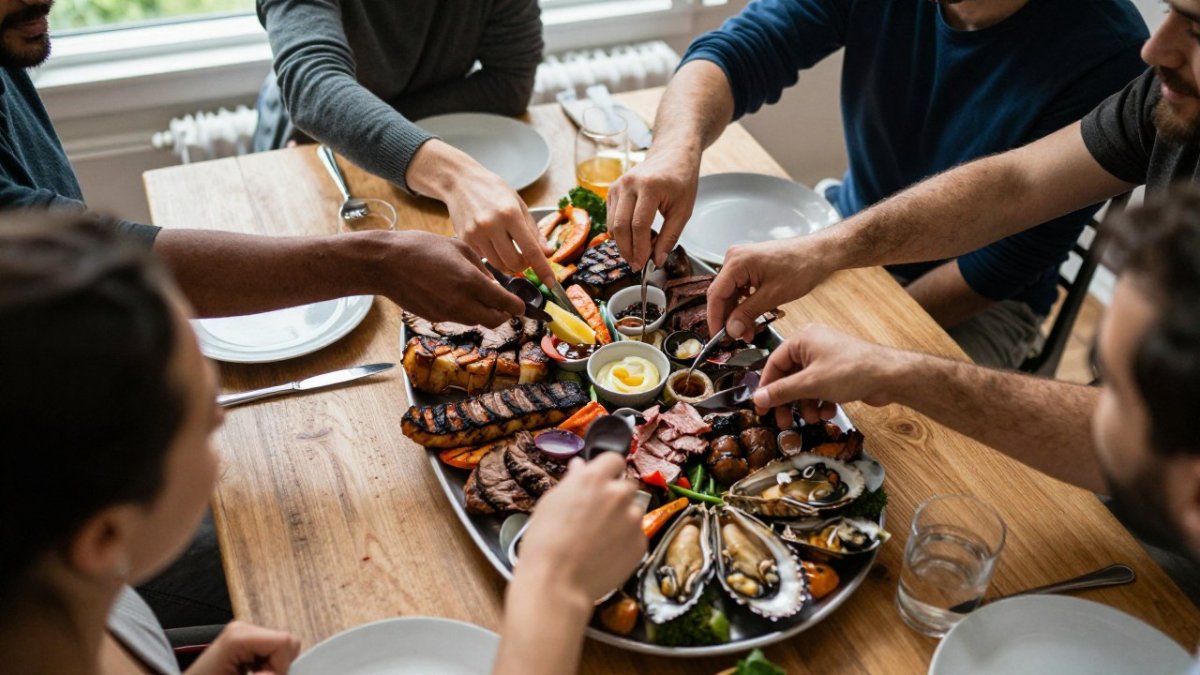
Check what goes on the platter and how many people it is designed to feed. A mixed grill that serves two people will not feed four, and a seafood platter with mostly shellfish may not suit guests who dislike it. Ask staff to describe the portion size in practical terms, such as how many guests one platter serves alongside side dishes.
Seafood Platters and Sourcing
Seafood platters are often the centrepiece of a group order, so it is worth asking where the fish and shellfish come from and how they are prepared. Ask about the origin of the seafood and how it is sourced.
Grilled Meats and Open-Fire Cooking
Open-fire cooking gives grilled meats a smoky, charred character that suits sharing. Many people find that grilled dishes travel well across a table, since they arrive hot and can be served in one go. To understand the technique behind it, read our complete guide to Nigerian open-fire cooking.
Choosing a Seafood Restaurant for Groups of 15 to 30
Once your group reaches 15 or more, the logistics matter as much as the food. Ask whether the restaurant can seat your party together, whether it offers a fixed-price group menu, and how it handles the timing of dishes so that the whole table is served at roughly the same pace.
For groups of 15 to 30, a restaurant with a dedicated group booking process is usually easier to manage than one that takes walk-ins. Ask about a deposit, whether a pre-order is needed and how the bill can be split. Clear answers to these questions tend to predict a smoother evening.
Planning Dietary Needs, Booking Rules and Total Cost
Dietary requirements and total cost are the two areas where group bookings most often go wrong, and they are the two areas most group-dining pages leave vague. Treat them as a checklist to settle before you pay a deposit.
On dietary needs, collect requirements at the point you invite people, not on the night. Ask each guest for allergies, whether they eat fish or meat, and any religious or cultural requirements, and pass the list to the venue in writing.
For vegan and gluten-free guests, ask whether the group menu includes at least one suitable dish per course or whether the kitchen will adapt a dish on request. Confirm whether adaptations change the per-person price. A common pattern is that set menus can be adapted but the price stays the same, so build that into your budget rather than assuming a reduction.
On total cost, work from the all-in figure rather than the headline menu price. Use this method:
- Take the per-person menu price in GBP and multiply by your headcount.
- Add the service charge percentage the venue applies to group bookings.
- Add a drinks allowance per head, based on whether the venue offers a drinks package or charges by the bottle.
- Add any minimum spend shortfall if your food and drink total falls below the venue's minimum.
- Check whether the quoted prices include VAT, and add it if they do not.
- Add any deposit, and confirm whether it is deducted from the final bill or held separately.
As an illustration, a £45-per-head menu for 20 guests gives £900 for food. A 12.5% service charge adds £112.50. A drinks allowance of £15 per head adds £300. The total is £1,312.50, or about £65.63 per person. If the venue quotes prices excluding VAT at 20%, the food element rises to £1,080 before service charge, and the total moves accordingly.
Booking rules vary more than most groups expect.
Watch out: a deposit described as 'non-refundable' and a minimum spend are different commitments, and a venue can apply both, so confirm the total exposure before you commit.
Put the answers for each shortlisted venue in one place, alongside the comparison figures from the previous section. The venue that answers these questions clearly and in writing before you book is usually the one that will handle the night itself with the same care.
Finding the Right Restaurant for Your Group Celebration
The right restaurant depends on what your group values most. For a relaxed catch-up with mixed tastes, a sharing menu with broad variety is usually the best fit. For a milestone celebration, look for a venue with a contemporary dining space, a clear group booking process and a menu that gives the event a sense of occasion. You can plan a private celebration at Monika Restaurant in Deptford and ask the team about your event.
Think about the atmosphere as well as the food. Music, performance and a lively room can turn a good meal into a memorable one. Monika Restaurants combines open-fire cooking with live entertainment and a contemporary space for groups and celebrations.
Before you decide, shortlist two or three venues and compare them using the factors above. Ask each one for a written quote for your exact group size and date. The venue that answers your questions clearly and quickly is often the one that will host your event best.
Booking Your Group Table at Monika Restaurants
If a sharing menu with seafood, grilled meats and platters suits your group, the next step is to reserve. Monika Restaurants hosts dates, dinners with friends and celebrations, and accommodates large group bookings for friends, family or colleagues.
Contact the restaurant with your headcount, preferred date and any dietary needs, and ask for a written quote covering food, drinks and any deposit. Once you have confirmed the details, you can book a table and start planning your order.
Frequently Asked Questions
What makes a restaurant menu suitable for group dining?
A suitable group menu offers set or sharing options that let everyone eat from the same dishes, so the table is not split into separate orders. It should include a mix of seafood, grilled meats and vegetarian dishes, clear per-person pricing and enough portion size to share. Ask whether the restaurant can accommodate your group size on the day, as menus for ten people often differ from those for thirty. Confirm the price includes service and drinks before you commit.
What seafood and grilled meat dishes work well for sharing?
Mixed seafood platters, whole fish and prawns work well at the centre of the table, as do grilled meats such as skewers, ribs and mixed grills. Dishes cooked over open fire tend to suit sharing because they arrive together and can be divided easily. Choose a mix of one or two rich dishes and lighter options so guests with different appetites are catered for. Check with the restaurant about portion sizes before ordering for a large group.
What should you ask a restaurant before booking for a large group?
Ask whether there is a minimum spend or deposit, how long the table is held, and whether a set menu or pre-order is required. Confirm group size limits, whether a private area is available, and how dietary requirements and allergies are handled. Find out if the price per person includes drinks, service and any entertainment. Written confirmation of these details avoids surprises on the night.
